


If you’ve spent any time researching performance vehicles, there’s a good chance you’ve heard the terms “turbocharger” or “supercharger” at least once. Both of these labels have seen widespread usage in vehicles ranging from grocery-getters to performance cars built for the track, but what do these terms really mean on a vehicle?
What Is Forced-Induction
Internal-combustion engines can be sorted into two categories, naturally-aspirated and forced-induction. A naturally-aspirated engine is one that solely relies on the influx of outside air from the air intake for the oxygen needed in combustion, meaning they’re limited by the volume and temperature of air they’re able to draw into the combustion chamber.
Forced-induction, on the other hand, is any engine that uses a system forcing compressed air into the engine. This can be accomplished in a variety of ways, namely with turbochargers and superchargers, however they all result in an increase in power output.
Types of Forced-Induction
Though there have been various methods of forced-induction since its original use in World War 2 prop-planes and early automotive development, the two systems that see widespread use today are the turbocharger and supercharger.
Supercharger
A supercharger is any belt-driven system that uses the power output of the engine to power an air compressor that forces pressurized air into the combustion chambers, resulting in increased oxygen content and by extension, increased engine power output.
The major difference between superchargers and turbochargers is that superchargers rely on the engine’s own power to create boost, which creates a “parasitic” situation where the operation of the supercharger decreases the output of the engine itself. While the supercharger will make up for this parasitic loss through the extra power produced, this self-reliance on power to turn the supercharger will result in a less-efficient system compared to a turbocharger without parasitic loss.
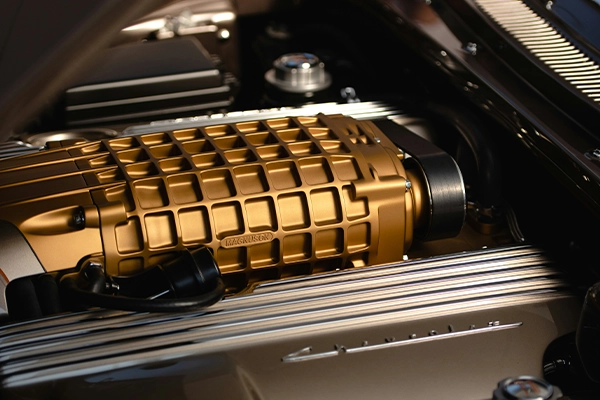
However, unlike turbochargers, the power produced by a supercharger is available throughout the entire rev range, while turbochargers often need to fully spool up before they can make a comparable amount of boost.
Superchargers, despite their downsides, are still used in modern vehicles. American muscle cars specifically are well-known for their use of superchargers and the accompanying whining sound, however you can still find superchargers on a number of other performance vehicles.
Turbocharger
Turbochargers are the most common form of forced-induction seen in modern vehicles. These systems take the hot exhaust gasses from the engine which are used to spin an internal turbine. This turbine compresses outside air within the housing and introduces it into the combustion chambers, increasing oxygen content and engine performance.
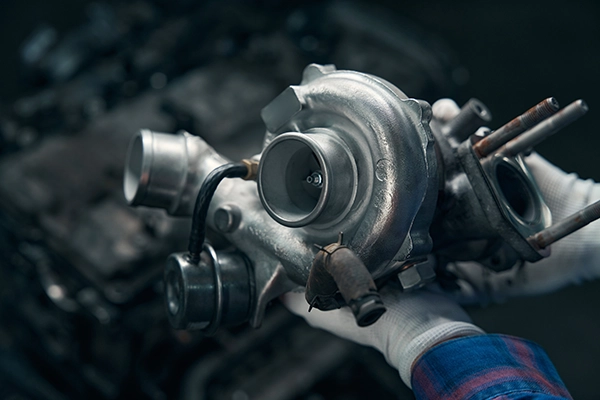
The major benefit of turbochargers over their supercharger counterparts is their lack of parasitic loss. As the turbine relies on spent exhaust gasses rather than the power output of the engine itself, turbochargers do not draw on power from the engine to operate.
Modern turbochargers can also significantly increase the efficiency of the engine, which is why turbocharger systems have found their way into a number of commuter-focused vehicles.
Turbochargers are often subject to “turbo lag”, which refers to the time it takes for the turbocharger turbine to spool up to the proper speed. Some turbo vehicles may feel sluggish on initial acceleration before the turbocharger finally spools up and kicks in full power. The amount of turbo lag a vehicle has is often proportional to its size, with larger turbos taking longer to spool. Turbocharger lag has become less of an issue over the years however with the introduction of advancements such as twin-scroll turbos.
Forced Induction Service & Installation in Rohnert Park
If you’re looking for forced-induction installation or tuning for your vehicle, don’t hesitate to contact the experienced team at Dynotuning in Rohnert Park! Our specially-trained technicians have the equipment and knowledge needed to provide your vehicle with the utmost quality of forced-induction installation and tuning.
Reach out to us today or give us a call to discuss the next steps for your vehicle with our friendly team!